JESTERS DRILL
AR/VR Development, Fall 2025 (academic project, supervised) - 2 Week design
Role: Solo Developer
Tools: Unity 6.2 URP, XR Interaction Toolkit, Meta Quest 3, Shader Graph, ElevenLabs, Git
Overview
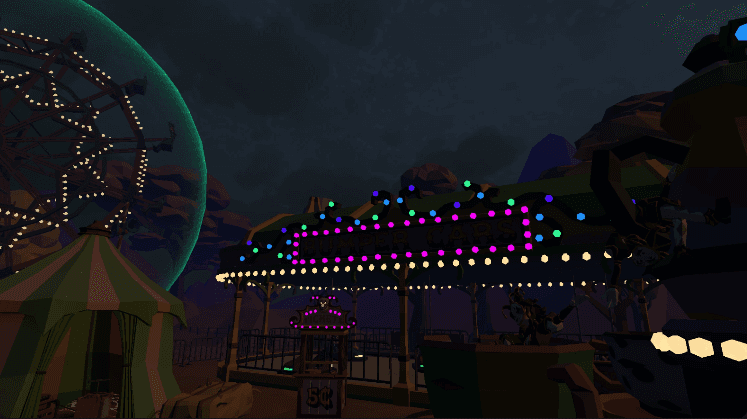
You're the new night shift security guard at Mallow's Carnival. It's your first night, and something is VERY wrong. The animatronic carnival mascots have malfunctioned and are wreaking havoc. Armed with experimental "non-lethal deterrent tools" — aka absurd weapons — you must complete increasingly ridiculous security protocols before sunrise.
I've always loved the aesthetic of carnivals — the colors, the rides, the slightly creepy vibes they can have. When I found the POLYGON Horror Carnival asset pack on the Unity Asset Store, I knew I had to build something with it. The idea of turning a fun carnival into a VR horror-comedy experience with malfunctioning animatronics and ridiculous weapons just clicked. It gave me a chance to create something visually interesting while pushing my VR mechanics in Unity as far as I could.
1
The Problem
Hospital navigation delays contribute to roughly 30% of preventable mortality in healthcare facilities. Traditional floor plan analysis is static — it can't reveal where congestion builds, how layout decisions affect emergency response times, or whether a design will fail before anyone walks through it.
Congestion bottlenecks are invisible in blueprints but deadly in practice
Architects and administrators make multi-million dollar layout decisions without simulation data
Traditional floor plan analysis is static — it reveals nothing about how people actually move through a space
2
System Architecture

Weapon Systems
Three weapons, three interaction models: the Bubble Gun traps static clowns in an expanding bubble and floats them upward; the Prize Dart Launcher pins and freezes animated enemies; the Confetti Rocket Launcher is a charge-to-fire explosive. Layer-based targeting (Bubbleable vs. Enemy) replaced an early tag-based system after cross-weapon collisions caused bubbles to capture moving enemies and darts to hit static ones.
Enemy & Zone System
Five zones (Ferris Wheel, Carousel, Haunted House, Fun House, Bumper Cars) unlock via a radio briefing sequence — player presses a radio button, briefing plays, and a custom dissolve shader removes the zone barrier. Animated enemies use trigger-based chase AI (sphere trigger + Transform.MoveTowards) after NavMesh pathfinding on the complex carnival geometry proved too unreliable to bake within scope.
Night Vision & Shaders
3
A full-screen post-processing shader (green tint, ellipse vignette) built in Shader Graph, wired to a wrist-mounted toggle. The original night vision implementation produced a persistent, untraceable circular camera mask — rather than chase the bug, the carnival scene was rebuilt from saved prefabs with a clean shader replacing the old system entirely.
Lighting & Lobby
Mixed baked/realtime lighting throughout, with light probes and reflection probes per zone. The lobby is a security office with three UI panels (monitor, radio control, equipment tracker) and a socket-interactor equipment collection system gating the exit door. Async scene loading between lobby and carnival prevents the XR input freeze that synchronous loading caused.
Playthrough
4
5