Heartbeat
The Challenge
Nurses spend significant portions of their shifts locating equipment and switching between fragmented tools rather than delivering care.
AdventHealth needed this experientially testable — placing leadership directly inside a nurse's workflow rather than a static prototype
1


The Mission:
How might we envision the future of smart hospitals where technology enables consumers and team members to find each other and everything?
The Goal:
How might we redesign hospital systems with empathy and human-centered care at the core?
Research & Descovery
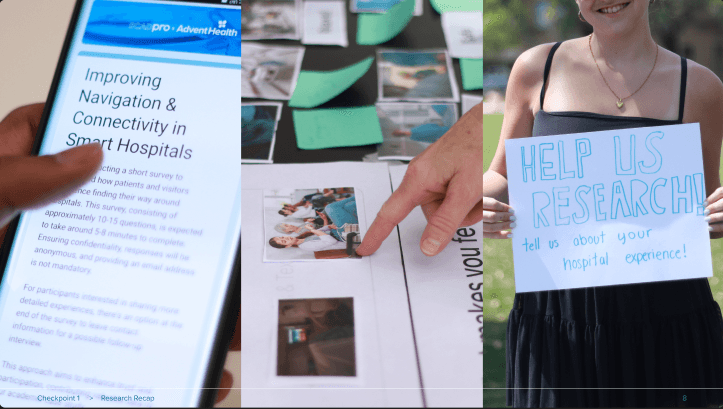


To understand the real challenges facing hospital staff and patients, our team conducted user interviews with nurses, clinical staff, and patient experience coordinators across multiple care units. We supplemented these with surveys measuring time spent locating equipment, communication gaps between team members, and daily workflow bottlenecks.
Key insights surfaced quickly: nurses lose significant portions of their shifts searching for equipment and personnel rather than delivering care. Fragmented communication tools create delays that compound across a shift. Clearer task visibility and streamlined coordination directly improve both efficiency and morale.
Pain Point: Time lost searching for tools and information is time taken away from patients.
2
The Build
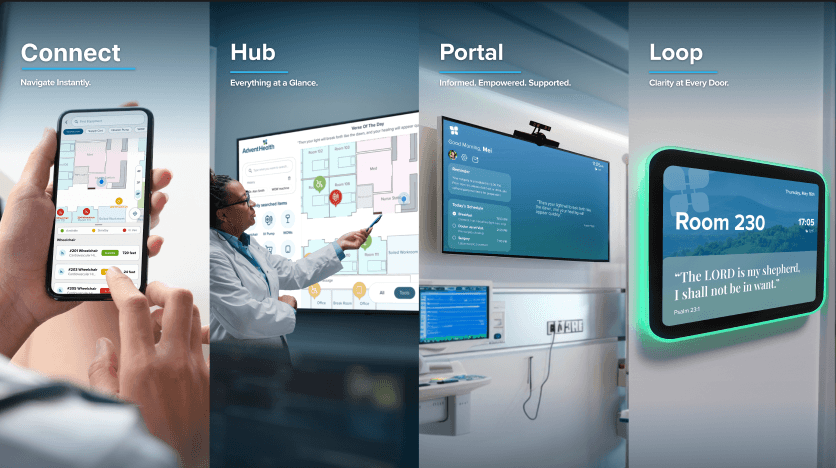
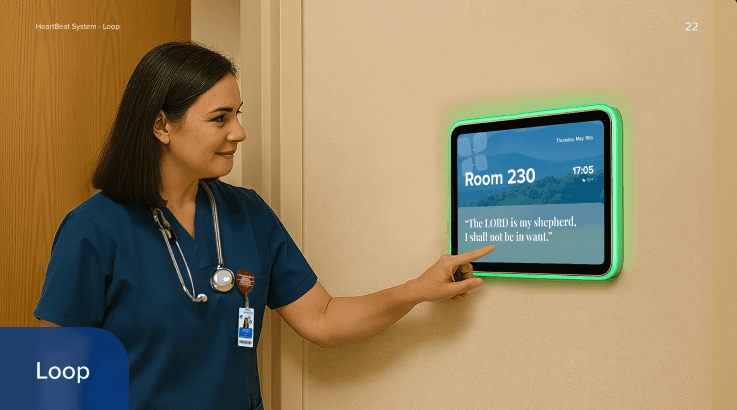
World-space VR representations of the full HeartBeat ecosystem placed at their real physical product locations inside the hospital simulation — Connect as a wrist-mounted HUD, Hub as a centralized dashboard, Portal screens outside patient rooms showing live status, Loop displays inside rooms for patient-facing information, and SmartHeart as the RFID badge tracking system. Point-and-click raycast interaction was used throughout for zero-onboarding accessibility, paired with teleportation locomotion and directional floor guidance.




3
VR Simulation
The simulation was built to answer one question — does the HeartBeat system work in practice? Stakeholders were placed directly inside Brenda's shift for a first-person experience of the system's impact.
Mechanics
Locomotion:
Teleportation with directional floor arrows, mirroring real nurse pathfinding through the hospital.
Interactions:
Point-and-click raycasting through Quest 3 controllers — zero learning curve for clinical stakeholders.
UI Architecture:
Portal and Loop displays reproduced spatially, exactly where the physical product would live.
4
User Testing

Before spatial feedback was implemented, first-attempt task success sat at 60%. After integrating directional floor navigation and world-space UI guidance, that rate reached 100% — a 40% improvement in overall task comprehension.
The results validated a core hypothesis: spatial feedback in an immersive environment communicates system logic more effectively than traditional UI patterns alone.
5
Impact

Spatial feedback design improved first-attempt task success from 60% to 100%, increasing overall comprehension by 40% — demonstrating that immersive environments can outperform traditional UI in communicating complex system logic.
Led a cross-disciplinary team of 18 across XR development, UI design, and clinical research tracks, applying design thinking methodology to a real healthcare systems challenge.
Recognized by AdventHealth leadership as a scalable innovation for hospital integration, validating the potential of empathetic, systems-level XR design in clinical environments.
6