FLOWLAB
SCAD x NVIDIA OpenUSD Challenge Hackathon — 48 hours
Role: USD Pipeline Engineer | Systems Architect
Team: Riya, Chloe Lo, Hyun Ha, Lily Vengco
Tools: Unity, C# | OpenUSD | NVIDIA Omniverse Composer | Maya | Python | GitHub

The Challenge:
Prompt from NVIDIA x SCAD: "Scale simulation using data-driven approaches, procedural workflows, and systems thinking with Houdini, OpenUSD, and NVIDIA Omniverse."
Our team chose healthcare. Hospital navigation delays contribute to roughly 30% of preventable mortality in healthcare facilities — and the industry has no data-driven way to evaluate a floor plan's traffic efficiency before construction begins.
1
The Problem
Hospital navigation delays contribute to roughly 30% of preventable mortality in healthcare facilities. Traditional floor plan analysis is static — it can't reveal where congestion builds, how layout decisions affect emergency response times, or whether a design will fail before anyone walks through it.
Congestion bottlenecks are invisible in blueprints but deadly in practice
Architects and administrators make multi-million dollar layout decisions without simulation data
Traditional floor plan analysis is static — it reveals nothing about how people actually move through a space
2
Pipeline
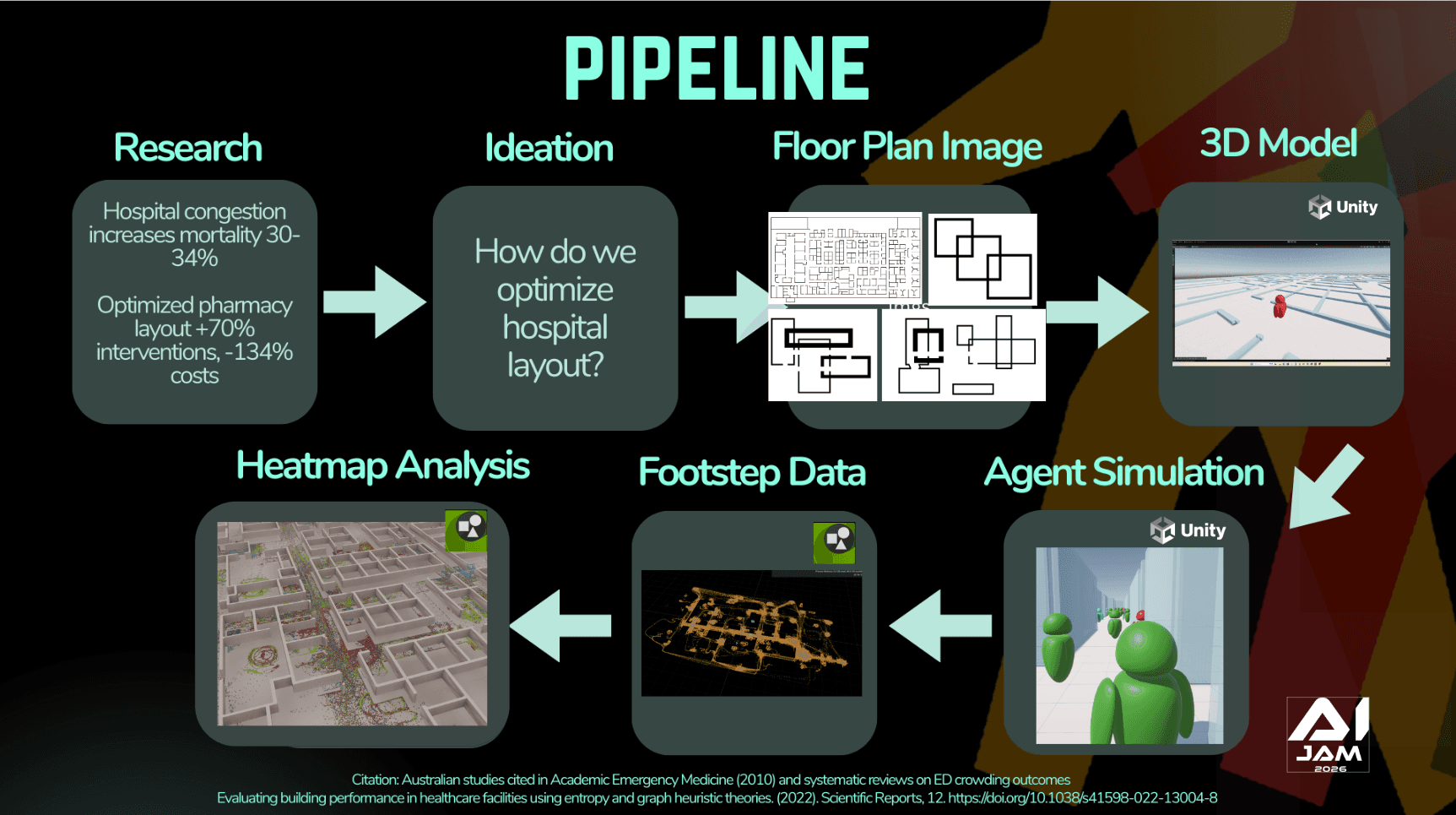
FlowLab procedurally generates a navigable 3D hospital environment from a 2D floor plan PNG, simulates realistic foot traffic across four behavioral agent types, and exports every footstep as structured metadata through an OpenUSD pipeline for heatmap visualization and bottleneck analysis in NVIDIA Omniverse Composer.


3
System Architecture
Procedural Environment Generation
Reads a black-and-white architectural PNG and automatically extrudes walls and corridors. NavMesh bakes dynamically after wall generation so agents navigate correctly through the space without manual setup.
Agent Behavioral System
Four archetypes model realistic hospital movement with urgency-based speed scaling from 0.7x to 1.5x base velocity:
Patients — entrance to waiting to room to exit, deliberate pace
Staff — patrol-based multi-room routing, fast and efficient
Emergency Cases — direct routing to trauma room, no queue
Visitors — standard routing with extended dwell times
OpenUSD Data Pipeline
4
Every footstep exports as structured metadata — position, timestamp, agent type, current room, velocity. Room-level statistics include utilization rate, peak occupancy, average wait time, and bottleneck flags. The USD scene hierarchy organizes geometry, navigation data, traffic data, and analysis into a clean, extensible structure.
Heatmap Visualization in Omniverse
Red zones identify bottlenecks. Blue zones reveal underutilized space. Timelapse playback shows how congestion builds across a simulation run. Interactive room statistics are accessible on hover.
End Point
Designed the full Unity to USD to Omniverse export pipeline
Architected the USD scene hierarchy and metadata schema
Integrated footstep data and room statistics into exportable USD format
Documented the shared data contract between simulation and visualization layers so teammates could build in parallel without blocking each other
Tested and validated all scene imports in Omniverse Composer
Traditional floor plan analysis is static — it reveals nothing about how people actually move through a space
Congestion bottlenecks are invisible in blueprints but deadly in practice
Architects and administrators make multi-million dollar layout decisions without simulation data
5